Read Between the Lines: What Your Subtitles Are Giving Away That the Director Hoped You'd Miss

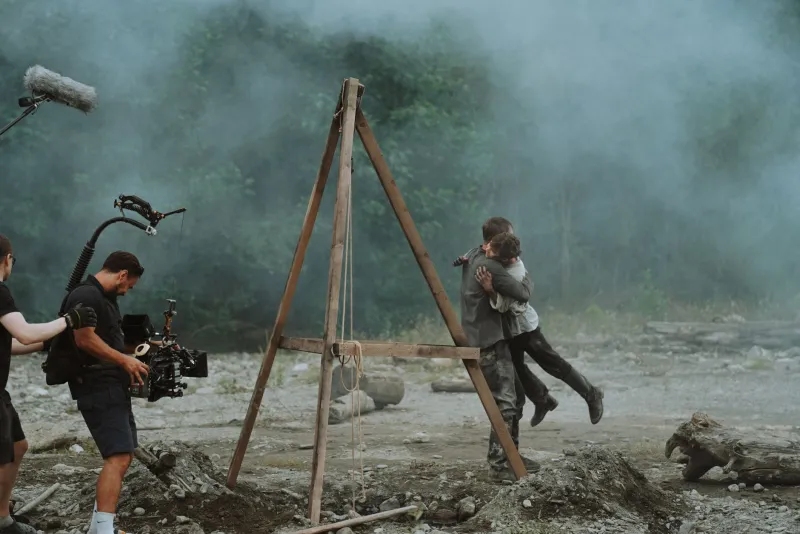
Photo: Unknown authorUnknown author, Public domain, via Wikimedia Commons
Somewhere between 50 and 60 percent of American streaming viewers watch with subtitles on. That's not a niche behavior anymore — it's the default mode for a massive chunk of the audience. And filmmakers, for the most part, are still making creative decisions as if nobody's reading along.
That gap is where things get interesting.
Closed captions and subtitles were designed as accessibility tools. They're supposed to translate sound into text so that deaf and hard-of-hearing viewers can follow the content. Simple enough. But in practice, the way captions describe non-dialogue audio — the emotional texture of a performance, the ambient mood of a scene, the sounds that a director uses to do psychological work — ends up creating a second, parallel layer of the narrative. One that sometimes tells a completely different story than the one on screen.
The Stage Direction Nobody Asked For
Here's the basic mechanics of how this plays out. Dialogue subtitles are straightforward: what someone says gets transcribed. But closed captions go further. They describe sound effects, music, and — this is the part that matters most — the manner of speech.
[laughs nervously]. [sighs heavily]. [voice breaking]. [speaks quietly, almost to himself].
These aren't neutral transcriptions. They're interpretations. Someone — a captioner, a post-production team, occasionally the production itself — made a judgment call about what a sound means and encoded that judgment into text that a huge portion of the audience is now reading in real time.
When a scene is designed to be emotionally ambiguous — when a director has deliberately left it unclear whether a character is relieved or devastated, sincere or lying — that [laughs nervously] in the corner of the screen is doing real damage to the intended experience. The ambiguity gets collapsed. The viewer has been told what to feel before they've had a chance to decide for themselves.
The Performance That Got Subtitled Into a Different Character
Think about how much work actors put into the space between emotions. The best screen performances live in that space — the moment where you genuinely can't tell if someone is telling the truth, the beat where grief and anger are indistinguishable from each other.
That work gets undercut when captions arrive with a verdict.
Consider a scene where a character receives bad news and the camera holds on their face. The actor has chosen to play it still, controlled, unreadable. The director has chosen to let that stillness breathe. The score is quiet. The whole sequence is engineered to make you lean in, to make you do the interpretive work yourself.
And then: [gasps softly]. [exhales shakily].
The mystery is solved before you solved it. The emotional beat that was supposed to land through your own inference has been handed to you pre-labeled. It's the cinematic equivalent of someone explaining a joke right before the punchline.
This isn't a hypothetical scenario. It plays out constantly in prestige dramas, psychological thrillers, and slow-burn character studies — exactly the genres where emotional ambiguity is doing the most narrative heavy lifting.
When Captions Catch What the Scene Tried to Bury
Now flip the dynamic. Sometimes the caption layer doesn't undercut the scene — it exposes something the production was actively trying to hide.
There's a category of performance choice that's meant to be subliminal. An actor delivers a line in a way that's designed to register unconsciously — a slight catch in the voice, a barely-there hesitation — without the audience consciously registering it. The goal is to seed doubt or unease without tipping the hand. When it works, viewers can't articulate why they don't quite trust a character. They just don't.
But if the caption reads [pauses, then forces a smile], that subliminal effect evaporates. What was meant to work below the level of conscious attention has been surfaced and labeled. The viewer isn't unsettled; they're informed. The performance's intended function has been completely rewritten.
This is especially consequential in mystery and thriller content, where a character's unreliability is supposed to accumulate gradually. Captions that describe performative behavior — [laughs too quickly], [avoids eye contact] — are essentially writing spoilers in real time.
The Music Description Problem
Dialogue and performance aren't the only casualties here. Captions also describe music, and music in film and TV is one of the primary tools directors use to manipulate emotional response without the audience's full awareness.
When captions read [tense, discordant music] or [ominous score], they're surfacing a directorial choice that was designed to operate through feeling rather than thought. The viewer who reads that description is now consciously aware that they're being cued toward tension or dread. The manipulation is visible. And visible manipulation is considerably less effective than the invisible kind.
Some streaming platforms have started distinguishing between "subtitles" (dialogue only) and "closed captions" (full audio description), giving viewers the option to choose. That's a meaningful distinction, but most casual viewers don't know it exists, and default settings tend to give them the full captioned experience regardless.
What Filmmakers Are Starting to Figure Out
The more sophisticated production teams are beginning to treat caption language as a creative decision rather than a post-production afterthought. If your captions are going to describe the emotional register of a performance, you'd better make sure that description aligns with what you actually want the audience to take from the scene.
Some shows have started building caption language into the writing and production process — treating it as essentially another layer of the script rather than a transcription service. That's the right instinct. If half your audience is reading along, you don't get to pretend the captions aren't part of the viewing experience.
But for every production that's gotten ahead of this, there are dozens still operating on the old assumption: that the text at the bottom of the screen is invisible infrastructure, neutral and inert.
It isn't. It's evidence. And right now, it's confessing more than most directors realize.