The Room Confesses Everything: How Production Design Hides the Plot in Plain Sight
Before a single actor delivers a line, the room has already talked.
That's not poetry. That's craft. The production designers, set decorators, and prop masters working behind the camera on your favorite films are operating less like decorators and more like co-writers — embedding thematic confessions, character histories, and plot-critical foreshadowing directly into the physical world of a scene. Most viewers absorb every last detail without consciously registering a single one. Which, by the way, is exactly the point.
At Video Detective, we treat every frame like a crime scene. And when you start dusting the backgrounds for fingerprints, what you find is staggering.
The Room Knows Who You Are Before You Open Your Mouth
Character is expensive to write and time-consuming to perform. But a room? A room can do that work for free, in about three seconds of screen time.
Take Knives Out (2019) — a film we've examined before for its visual clues — but zoom out from the mystery mechanics for a moment and look at the Thrombey estate itself. Every family member's space in that house is a personality dossier. Richard and Linda's wing is old-money formal, stiff, performative. Joni's section leans into curated bohemian warmth — the kind that costs more than it admits. Walt's office is cluttered with the artifacts of a man who manages other people's legacies without building one of his own. Production designer David Crank didn't dress those rooms arbitrarily. Each space is a confession about who these people are and, critically, what they're capable of.
You didn't need the script to tell you the Thrombeys were a family eating itself alive. The house already filed that report.
Objects as Accomplices
Props are the unsung informants of cinema. They sit in the background, say nothing, and give up everything.
In The Shining (1980), Stanley Kubrick and production designer Roy Walker loaded the Overlook Hotel with deliberate visual contradictions — furniture arrangements that defy architectural logic, Indigenous American artwork placed alongside colonial imagery, a carpet pattern that reappears in contexts that shouldn't be geometrically possible. Kubrick was doing something specific: building a space that the audience's brain registers as wrong before the horror becomes explicit. The room is already lying to you. You just don't know it yet.
Or consider the quietly devastating work in Marriage Story (2019). Production designer Jade Hetherington dressed Charlie's New York apartment with the careful chaos of a man who is professionally brilliant and domestically adrift — stacked scripts, half-used rehearsal spaces, a kitchen that suggests someone who eats but doesn't cook. Meanwhile, Nicole's LA space gradually accumulates warmth and intention as the film progresses. The production design is tracking an emotional arc that the characters themselves are still figuring out. You feel the drift before you're told about it.
Color as Confession
If props are informants, color is the wiretap.
The production design team on American Beauty (1999) deployed red with almost prosecutorial precision. Red roses, red door, red sports car — but also, critically, the absence of red in spaces where Lester Burnham has surrendered to routine. The color bleeds back into the frame as he reclaims agency. It's not subtle when you isolate it. But in motion, as part of a full scene? Most audiences process it emotionally without ever naming what's happening.
Pan's Labyrinth (2006) pulls a similar trick in the opposite direction. Guillermo del Toro and production designer Eugenio Caballero made a deliberate decision to drain the real world of warmth — military quarters rendered in cold greens and grays — while the fantasy sequences explode in amber and gold. The visual argument the film is making — that imagination is more real than fascism — is embedded in the palette before a single word of thematic dialogue is spoken.
Room Layout as Dramatic Architecture
Where furniture lives in a scene is not accidental. The blocking that directors and actors work through is shaped, often invisibly, by production design decisions made weeks earlier on a drafting table.
In The Godfather (1972), production designer Dean Tavoularis constructed the Corleone compound with specific sightlines and power geometries in mind. Rooms narrow toward the patriarch. Doorways frame characters as suppliants before they even speak. When Michael Corleone moves through that house across the trilogy, you can track his transformation partly through how the architecture responds to him — spaces that once diminished him begin to center him.
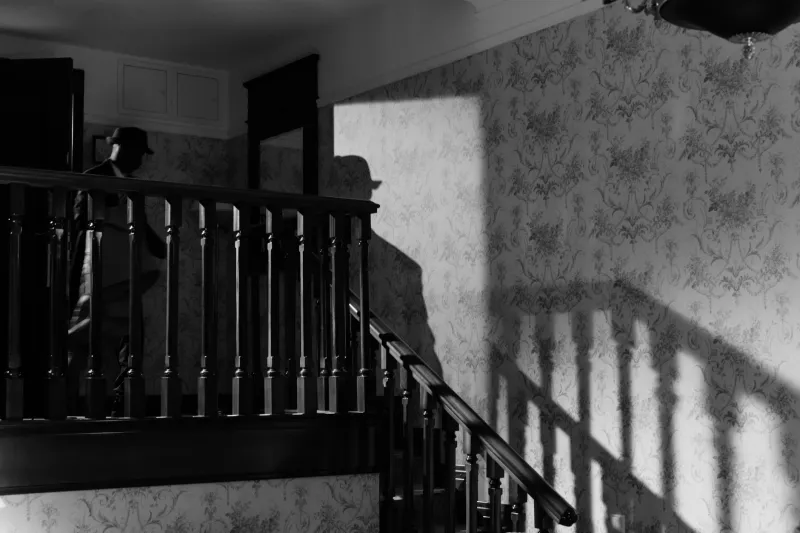
Similarly, in Parasite (2019), Bong Joon-ho and production designer Lee Ha-jun built the Park family's modernist home as a vertical argument. The wealthy live in light; the poor descend into darkness. Every staircase is a thesis statement. The basement — and what it contains — is foreshadowed by the logic of the house itself. When the third-act revelations hit, the architecture has already made them feel inevitable.
The Stuff You Never Notice Is Doing the Most Work
Here's what makes this particular form of filmmaking so fascinating from an investigative standpoint: the most effective production design operates below conscious awareness. If you notice the prop, the designer may have overplayed their hand. The real craft is in the detail that lodges in your subconscious and pays out later.
Think about the recurring appearance of fish imagery in The Godfather — not just the infamous line, but in paintings, in decor, in background details. Or the way clocks and time-related objects accumulate in Eternal Sunshine of the Spotless Mind (2004) without ever becoming obvious. Or how the Dunder Mifflin office in The Office gradually, over nine seasons, fills with the accumulated detritus of people who have been stuck in the same room too long — until it starts to look like the inside of a long-term relationship, which is exactly what it is.
Production design at this level isn't decoration. It's subtext made physical.
Dust for Fingerprints
The next time you sit down to watch something — anything, really — give yourself the first sixty seconds of every new scene to just look at the room. Not the actors. Not the dialogue. The room.
What's on the shelves? What's the color of the walls, and does it match or clash with the character who lives there? What's slightly out of place? What's missing that you'd expect to find?
Production designers are working a case before the cameras roll. They're planting evidence, establishing alibis, and quietly confessing the plot through objects and architecture while everyone else is busy watching the faces.
The room already knows what's going to happen. It's been waiting for you to ask the right questions.