No Body, No Boundaries: How Off-Screen Deaths Give Filmmakers Total Control Over Your Suspicions
Here's something worth investigating: in a medium built entirely on showing you things, some of the most consequential moments in cinema history involve the deliberate choice to show you nothing at all.
When a character dies off-screen, audiences tend to accept it as a practical decision — budget constraints, a squeamish rating, maybe the actor had a scheduling conflict. But spend enough time rewatching the films that hinge on these invisible deaths, and a pattern starts to emerge. The camera's refusal to confirm a death isn't an oversight. It's a loophole, and filmmakers exploit it with surgical precision.
This is the case we're cracking today: how Hollywood weaponizes the off-screen death to manipulate suspicion, stall resolution, and keep you guessing long after you should've known better.
The Evidence Problem
In any good detective story, the absence of a body is practically a confession that something's being hidden. "No body, no crime" isn't just a legal defense strategy — it's a narrative contract. When a film withholds the visual confirmation of a death, it's essentially handing the audience an unsigned check. You're told the account exists. You're told there are funds. But you never actually get to verify either.
This matters because film is a visual medium. We trust what we see. We're trained to. When a character is shown dying on screen, the story closes a door. When that same death happens off-screen — described by another character, implied by a cut, or simply referenced after the fact — that door stays open just enough to let doubt squeeze through.
And doubt, in the hands of a skilled filmmaker, is the most valuable currency in the room.
Case File: Gone Girl and the Unreliable Disappearance
David Fincher's 2014 adaptation of Gillian Flynn's novel is practically a masterclass in this technique. For the first half of the film, Amy Dunne is simply gone — and the audience is fed a carefully curated trail of evidence pointing toward her husband Nick. There's no body. There's no confirmed death. And that absence is the entire engine of the story's first act.
Fincher and Flynn understand something crucial: without visual proof of death, the audience can't fully commit to grief, guilt, or accusation. We're held in a permanent state of suspension. Is she dead? Was she taken? Did she run? Every theory is equally valid precisely because the camera has refused to adjudicate. The off-screen "death" doesn't just create mystery — it creates a kind of narrative democracy where any suspect, any theory, any reading of the evidence feels plausible.
When the truth finally arrives, it reframes every prior scene. But that reframing only works because the film never showed its hand visually. The absence was the misdirection.
The Classic Playbook: Psycho and What Hitchcock Knew
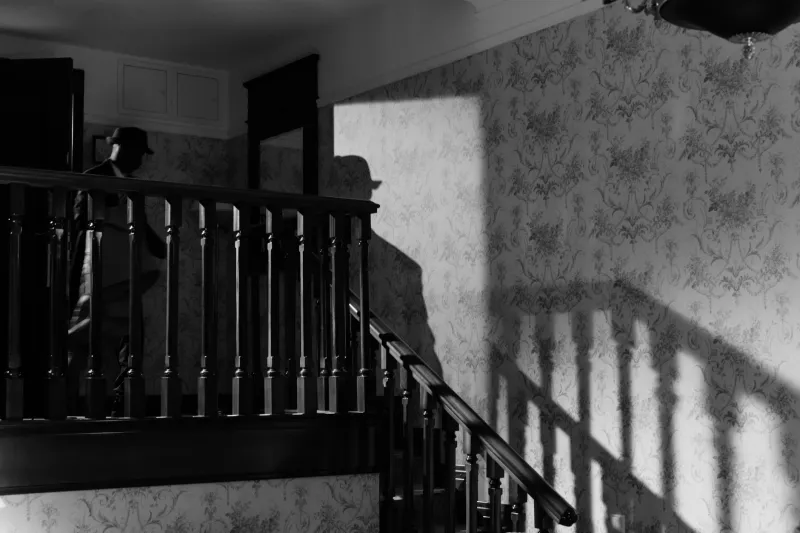
Alfred Hitchcock was arguably the first filmmaker to fully weaponize the off-screen death as a plot mechanism rather than just a production workaround. The shower scene in Psycho is famous for what it shows — but consider what it withholds. Despite being one of cinema's most visceral murder sequences, Hitchcock's editing ensures you never actually see the knife make contact with Marion Crane's body. The violence is implied through montage, sound, and reaction.
This wasn't just about dodging the censors. Hitchcock understood that the audience's imagination, properly directed, would always fill in something more disturbing than anything he could put on screen. By controlling what the camera confirmed, he controlled the emotional reality of the scene — and by extension, the audience's psychological state for the rest of the film.
That principle scales up. When filmmakers apply it not just to the mechanics of violence but to the fact of death itself, the manipulation becomes even more complete.
When the Dead Aren't Confirmed: Skyfall and the Franchise Loophole
Large-scale franchises have their own relationship with off-screen deaths, and it's a complicated one. The James Bond series has leaned on this technique repeatedly — characters are presumed dead, confirmed dead by dialogue alone, then conveniently resurrected when a sequel demands it.
In Skyfall, the film opens with Bond himself going off-screen in a presumed death — shot and falling into water, declared dead by MI6. The audience knows, intellectually, that Bond will survive. The franchise won't kill its own protagonist. But the film still uses the unconfirmed death to restructure the entire story's emotional stakes. Bond is "dead" long enough for the world to move on without him, for M to mourn him, for the institution to recalibrate.
This is the franchise loophole: off-screen death functions as a narrative pause button. It lets the story reset, introduce new dynamics, and manipulate audience loyalty — all without the permanent consequences that an on-screen, visually confirmed death would demand.
The Villain's Disappearing Act
Off-screen deaths aren't just used for protagonists or victims. Some of cinema's most effective misdirection involves keeping the audience uncertain about whether a villain is actually gone.
Think about how many horror franchises have survived on this exact mechanic. Michael Myers, Jason Voorhees, Hannibal Lecter in various incarnations — these characters have all been "killed" in ways that the camera declined to fully confirm, leaving just enough ambiguity for a sequel to walk through. But beyond the franchise economics, there's a storytelling function: an unconfirmed villain death keeps the threat alive in the audience's nervous system. You can't fully exhale. You can't fully celebrate. The tension doesn't resolve because the visual evidence was never presented.
Filmmakers who understand this use it deliberately even in standalone films. The villain who disappears off a cliff, into water, into shadow — that's not sloppy writing. That's a filmmaker choosing to leave the jury out.
What the Camera Refuses to Show You
Here's the investigative takeaway: in film, the camera is always making choices. Every frame is an argument about what matters, what's real, what you're allowed to know. When a death happens off-screen, that's not a gap in the story — it's a deliberate editorial position.
The filmmakers are telling you, in the clearest possible terms: we're not going to confirm this for you. And in that refusal, they're keeping the case open. They're preserving your uncertainty. They're maintaining their own leverage over what you believe and when you're allowed to believe it.
The most calculated decisions in any film aren't always the things you see. Sometimes they're the things the camera quietly, deliberately, strategically turns away from.
Next time a character dies off-screen, don't accept it as a given. Treat it like a detective would treat a missing witness — as the most suspicious thing in the room.