You're on Camera: How Surveillance Footage in Film Tells You Exactly Who Not to Trust
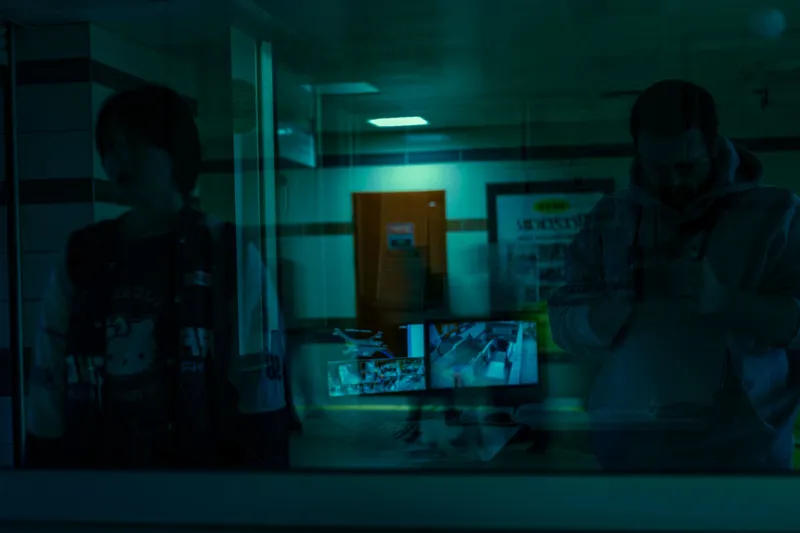
Let's think about what surveillance footage actually means in real life. It's evidence. It's documentation. It's supposed to be the one witness that can't lie, can't be coached, and doesn't have an agenda. So it's genuinely fascinating — and more than a little suspicious — that filmmakers use it so consistently to deceive their audiences.
The surveillance angle has become one of cinema's most reliable pieces of visual shorthand. Drop a scene into grainy CCTV resolution and something in the viewer's brain shifts. We lean forward. We trust it more. We assume we're getting unfiltered reality. And that assumption is exactly what a skilled director is counting on when they decide to show you something through a security camera — because what they're actually doing is controlling your perception with surgical precision.
The Grammar of Distrust
Before we get into specific examples, it's worth laying out what surveillance aesthetics actually communicate on a technical level. CCTV and found-footage framing share a few consistent visual characteristics: fixed or limited angles, reduced image quality, timestamp overlays, fisheye distortion, and the absence of conventional cinematic lighting. All of these elements signal, on a subconscious level, that we're outside the curated world of the film and inside something more "real."
But here's the catch: the director still chose that angle. The editor still cut to it at a specific moment. The production designer still decided what would and wouldn't be in frame. The surveillance aesthetic is a costume the film puts on to make you lower your guard — and the moment your guard drops, the misdirection moves in.
Heist films have been exploiting this for decades. When a crew is casing a location and the audience sees the security camera layout, we're not just receiving logistical information. We're being shown what the system can't see. Those blind spots aren't just tactical for the characters — they're tactical for the storyteller. Anything that happens in a surveillance blind spot is information the film has deliberately withheld from its own diegetic record, which means it's information you're not supposed to have yet.
The Reliability Trap
Psychological thrillers have taken this further than any other genre, using surveillance footage specifically to manufacture false reliability. There's a long lineage of films — Rear Window being the obvious grandfather — built on the premise that watching something through a frame doesn't mean you're seeing the truth of it. Contemporary thrillers have updated that premise by making the frame digital and institutional.
When a film cuts to CCTV footage of a character doing something incriminating, audiences tend to accept it at face value. Security cameras, we've been culturally conditioned to believe, don't editorialize. But in a fictional context, they absolutely do. The director chose what the camera captured. More importantly, they chose what it didn't capture — and the space between those two decisions is where the real story lives.
Consider how often a pivotal surveillance clip is shown to be incomplete, corrupted, or conveniently angled just wrong enough to be ambiguous. That's not a technical failure in the story world. That's a filmmaker telling you, in the most coded language possible, that the official record is unreliable — and by extension, that whoever is presenting that record to you has an interest in what you conclude from it.
What the Camera Position Is Actually Saying
Here's a specific thing to watch for: the relationship between surveillance angle and character positioning. When a film frames a character from a high, distant, surveillance-style angle, it's not just an aesthetic choice. High angles diminish subjects. They make people look small, cornered, and exposed. When that angle is coded as institutional — a security camera, a drone feed, a bodycam — it adds a layer of judgment to the diminishment. The character isn't just small in the frame; they're surveilled. They're under scrutiny.
Pay attention to which characters get the surveillance treatment and which ones don't. In films where a traitor is eventually revealed, it's worth going back to check whether that character was ever shown through an impersonal, institutional lens earlier in the runtime. More often than not, they were — and the camera was telling you something the script was still keeping quiet.
Conversely, characters who are framed warmly, with conventional cinematography and deliberate lighting, are being protected by the film's visual language. The camera is vouching for them. When the surveillance aesthetic appears, that vouching disappears — and the character is on their own.
Missing Footage as Active Narrative
Perhaps the most sophisticated version of this trick is the conspicuously absent surveillance record. In both heist films and thrillers, the moment when a security feed goes dark, gets wiped, or simply doesn't cover the relevant window of time is almost always a narrative marker rather than a plot convenience.
When footage is missing, the film is doing two things simultaneously. It's creating a mystery around what happened in that gap. And it's identifying, at least implicitly, that someone with access to the system had a reason to create that gap. The absent footage is itself a kind of evidence — it just points at whoever had the means and motive to make it disappear.
The next time a film cuts to a surveillance feed, resist the instinct to treat it as unmediated truth. Ask instead: what is this angle designed to make me believe? What's outside its field of view? And who benefits from me accepting this particular version of events?
The camera never lies, sure. But the person who decides where to point it? That's a different conversation entirely.